Whether you’re after a reliable nightly clean or a long-term commercial partner, a solid code of conduct makes all the difference. Clear expectations upfront lead to safer sites, smoother communication and far fewer surprises down the track.
Key Takeaways
- A proper code of conduct protects people, property and reputation, not just shiny floors
- Cleaning companies should link their code directly to WHS responsibilities and risk management
- You can and should ask your cleaners how they train staff, handle issues and report incidents
- A clear code sets the standard for behaviour when no one’s watching
A lot happens in a building after everyone goes home. Lights dim, alarms beep, and our team quietly moves through offices, gyms, clinics and common areas across Sydney. We handle keys, alarm codes, chemicals and sometimes sensitive information. A strong commercial cleaning code of conduct is what transforms after-hours work from “hope for the best” into something safer, structured, and genuinely professional.
What is a commercial cleaning code of conduct?
To us, a code of conduct is the backbone of how we work. It sets expectations for how our cleaners behave on and off-site, how they treat your staff, your customers and your property, and how they manage their own safety and the safety of others. It guides everything from how we communicate to how we respond when something isn’t right.
A proper cleaning code touches on respect for property, confidentiality, WHS responsibilities, professional behaviour, emergency procedures and reporting pathways. Without a clear code, every shift becomes a matter of personal interpretation. That’s not how we operate, especially when clients trust us with their spaces outside normal hours.
Why cleaning codes matter for WHS and your business
Bringing WHS into everyday cleaning
Under Australian work health and safety laws, a person conducting a business or undertaking has a primary duty of care to keep workers and others safe as far as reasonably practicable. Resources from Safe Work Australia make it clear that businesses must manage risks like slips, trips, chemical exposure and poor housekeeping.
Cleaning is part of that duty. Wet floors, incorrect chemical use, blocked exits and poor hygiene all create risks. Our code transforms broad WHS responsibilities into clear day-to-day behaviour: using chemicals correctly, keeping exits unobstructed, reporting hazards immediately and following your site’s safety rules.
This same principle applies across other building services. Whether it’s cleaners, maintenance teams or a leading commercial glazier installing or servicing glass, clear conduct standards help ensure everyone works safely, respects the site and communicates hazards properly. When each contractor understands their responsibilities, the overall risk profile of your building is significantly reduced.
Trust, access and accountability
Because most of our work happens after hours, our cleaners often lock up at night, set alarms and move through spaces unsupervised. That requires trust, and trust requires expectations. Our code sets out clear rules for confidentiality, key handling, respecting belongings and professional conduct at all times.
It also clarifies what happens if something goes wrong, so you’re never left guessing.
What a strong commercial cleaning code should include
A reliable code of conduct usually covers:
- Behaviour, values and professionalism
- WHS rules, PPE, risk management and hazard reporting
- Respectful workplace guidelines
- Confidentiality and privacy
- Conflicts of interest and simple gift policies
- Reporting pathways for incidents or concerns
Here’s how it plays out compared to a company without one:
| Cleaning company with a clear code | Cleaning company with no clear code | |
| WHS practices | Documented training and safety rules | Depends on habits and shortcuts |
| Confidentiality | Clear privacy expectations | “Use your judgement” |
| Handling complaints | Structured reporting process | Inconsistent and reactive |
| Staff behaviour | Written values and accountability | Unspoken and unpredictable |
The difference becomes crystal clear when problems arise.

Real-world examples: how our code plays out onsite
Example 1: Sensitive documents on a desk
If we walk into a meeting room and find confidential documents scattered across a table next to an unlocked laptop, our team knows exactly what to do: avoid reading anything, tidy respectfully, protect confidentiality and log the concern if it’s a recurring issue.
Example 2: A slip hazard waiting for morning staff
If a cleaner sees a spill in a high-traffic area, the response isn’t optional. We clean it, put up signage and record the incident so your team is aware. That’s part of our WHS expectations.
Example 3: When time pressure invites shortcuts
If a shift runs behind, our cleaners don’t hide missed tasks. They escalate it so we can adjust the workload or tweak the schedule. Transparency beats shortcuts every time.
Example 4: Infection control in shared spaces
In places like clinics or health-adjacent offices, our code guides correct disinfectant use, touch-point frequency and basic hygiene practices to support your infection-control needs.
These everyday moments are where professionalism actually shows.
How our code supports WHS responsibilities
WHS duties overlap between you and us. You control the site overall. We control how cleaning is carried out. A proper code helps us meet our WHS duties by encouraging hazard reporting, following your site rules, respecting restricted areas and working cooperatively with your WHS processes.
Our aim is to make compliance smoother for you, not harder.
Questions to ask any cleaning provider
If you’re comparing companies, here are simple questions that reveal a lot:
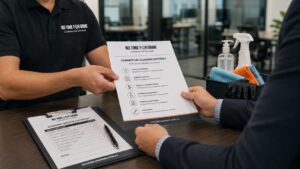
- Can we see your code of conduct?
- How do you train cleaners on WHS and site rules?
- What happens when staff identify a hazard or near miss?
- How do you handle confidentiality onsite?
- What’s your process if we report a concern?
Clear answers show structure. Vague answers show risk.
Where No Time For Grime fits in

We take codes of conduct seriously because they’re the framework behind every shift we complete. They influence how we clean, how we communicate and how we support WHS in every workplace we step into.
If you’d like to see how our standards translate into everyday cleaning, start with our full list of commercial cleaning services. It gives a good overview of what we do across offices, gyms, strata sites and more.
To understand how we deliver consistency from one visit to the next, our step-by-step Our Process walkthrough explains how we manage expectations, quality and communication.
If you’re comparing different providers, you might find our article on choosing the right commercial cleaning company useful, and our blog on why commercial cleaning is a smart investment helps break down long-term benefits.
FAQs about commercial cleaning codes of conduct
Do I really need to see my cleaner’s code?
It’s not mandatory, but it’s smart. A code shows how we protect confidentiality, manage risk and uphold behaviour standards. It’s a clear sign of professionalism.
How does a code support infection control?
Our code covers touch-point cleaning, correct chemical use, product dwell times and hygiene practices. It ensures cleaners support your infection-control efforts instead of unintentionally undermining them.
Who is responsible for WHS, us or the cleaner?
Both. You control the site. We control how we clean. A shared approach backed by a clear code makes compliance smoother for everyone.
Should a code include bullying and harassment rules?
Both. You control the site. We control how we clean. A shared approach backed by a clear code makes compliance smoother for everyone.
Final thoughts
A commercial cleaning code of conduct is more than a formality to us. It’s the backbone of how we keep your workplace safe, consistent and ready for the day ahead. When our team is clear on expectations, WHS responsibilities and professional behaviour, it shows in the way your building looks and feels every morning.
If you’d like to see how we put these standards into practice, feel free to explore our site, learn more about our commercial cleaning services, or visit our homepage to get a feel for who we are. And if you’re ready to chat about creating a safer, cleaner and more reliable workplace, call us.